


Carbon-Free Mobility: from Net Zero to Net Positive
Cebisa Mafukuzela, Sustainability Communications and Engagement Manager at Solid Green, explores the move towards Net Positive in the context of carbon-free mobility.
7When we talk about the future of sustainability, the conversation has officially shifted. For years, the global benchmark for corporate and environmental responsibility was Net Zero which focused on minimising negative impacts, offsetting footprints, and aiming for neutral equilibrium. But as the climate reality accelerates, neutrality is no longer enough.
At Solid Green, our next frontier is moving from Net Zero to Net Positive. We are no longer just looking to do less harm; we are aiming to create ecosystems, buildings, and operational practices that are actively regenerative and restorative.
Nowhere is this shift more tangible, and more challenging, than in the space of Carbon-Free Mobility.
The SDG Blueprint for E-Mobility
Decarbonising how we move is a cornerstone of the United Nations Sustainable Development Goals (SDGs). Transport electrification isn’t just an isolated technological upgrade; it is a critical lever that intersects with multiple global targets:
- SDG 7 (Affordable and Clean Energy): True carbon-free mobility relies on an energy grid anchored in scalable, renewable energy sources. Driving an EV is only as clean as the power charging it.
- SDG 9 (Industry, Innovation, and Infrastructure): Transitioning away from fossil fuels requires an unprecedented infrastructure rollout, expanding resilient smart grids and localised technical innovation.
- SDG 11 (Sustainable Cities and Communities): Decarbonising urban transit hubs and corporate travel pathways reduces localised pollution, creating healthier, low-carbon value chains where people live and work.
- SDG 13 (Climate Action): With the transport and energy sectors driving the vast majority of global greenhouse gas emissions, immediate transition strategies are non-negotiable to limit global warming.
The Reality of the Transition: A Case Study on the Road
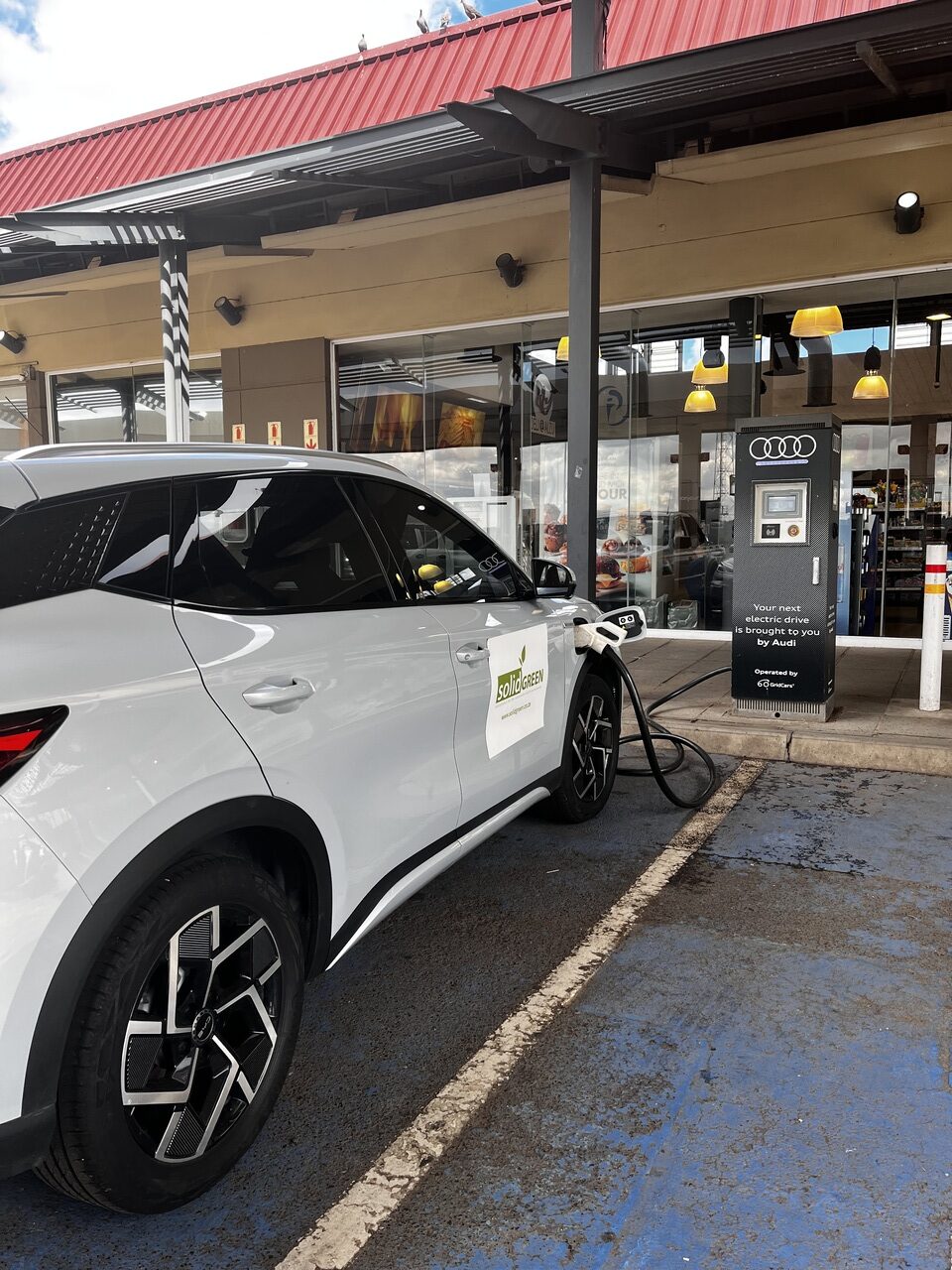
To communicate sustainability authentically, you have to live it. I recently took our company’s fully electric BYD Atto 3 on a 367 km journey from Johannesburg to Nelspruit for the DAS Conference.
On paper, the “Extended Range EV Trip Plan” was seamless. In reality, it was a sharp lesson in the vulnerabilities of our current transitional infrastructure. A leisurely charging stop to view wildlife left us with no buffer upon arrival, and a return-leg charging station abruptly went offline mid-charge, resulting in a tech-support saga that added an extra hour and a half to the drive. Standing at a dark, unresponsive charging bollard in the late afternoon, the gap between intent and infrastructure became glaringly obvious. It highlighted a core truth of the sustainability transition: zero-emissions technology is commercially viable right now, but its long-term reliability hinges entirely on systemic resilience.
South Africa’s electric vehicle landscape currently exists in a delicate balance between rapid, innovative “wins” and severe systemic “setbacks.” On the winning side, market momentum is accelerating, with new energy vehicle (NEV) sales climbing to over 16,700 units in 2025 which is nearly 19 times the volume recorded in 2021.
Additionally, the International Energy Agency previously ranked South Africa fifth globally in terms of the ratio of public EV chargers to vehicles, highlighting an incredibly proactive rollout of public charging points relative to early adoption. However, the critical vulnerability lies in the structural framework supporting this network. The traditional grid, constrained by aging infrastructure and transmission bottlenecks, was never designed to handle the heavy demands of large-scale EV fast-charging. Consequently, traditional grid-tied stations are heavily exposed to energy insecurity and regional power cuts. This creates friction between a booming vehicle market and an unstable grid.

The Net Positive Frontier: Regenerative Mobility
This is where the shift from Net Zero to Net Positive becomes crucial.
A Net Zero approach to mobility simply means swapping an internal combustion engine for an electric one and offsetting the remaining operational footprint. It keeps us at a baseline of zero impact.
A Net Positive approach, however, looks at the holistic management of the entire lifecycle and system. It means moving toward circular shared value:
- Grid-positive charging: Moving beyond standard grid-tied EV chargers to localised, solar-powered corporate microgrids that feed clean energy back into the national system when vehicles aren’t charging.
- Infrastructure resilience: Building charging networks equipped with decentralised battery storage and generator backups so that localised outages don’t stall the macro-economy.
- Circular life cycles: Taking into account the choice of materials, battery supply chains, and future use cycles of the vehicles themselves, preventing resource depletion from the outset.
Walking the Walk
We can design and certify the greenest, highest performing buildings in Africa, but those buildings do not exist in a vacuum. They are connected by human beings who need to move between them.
True carbon-free mobility requires us to push past the comfort zone of simple compliance. As we navigate this structural global transition, the hiccups on the road are inevitable – but they are indicators of where we must build stronger, smarter, and more resilient systems. The goal is no longer just to reach the destination with a neutral footprint. It’s to leave the road better than we found it.

