



Building Resilience Where It Matters Most
Adri Fourie, Head of Department: Sustainable Cities & Research, shares why Solid Green is investing in the well-being of sustainability professionals.
7At Solid Green, we’ve always believed that our most valuable asset isn’t the tools we use or the buildings we certify – it’s the people behind the work.
This article is the first in a new series exploring how we’re embedding workplace resilience into our operations because we believe that sustainability starts from within.
The built environment is under increasing pressure to deliver sustainability outcomes that are urgent, complex and transformative. Yet behind every Net-Zero goal, precinct framework and ESG strategy is a team navigating competing demands, tight deadlines, climate anxiety, and the emotional weight of caring deeply about the future.
So we asked ourselves: how do we build a future that is resilient if our teams are running on empty?

Resilience Is a Strategic Priority, Not a Soft Skill
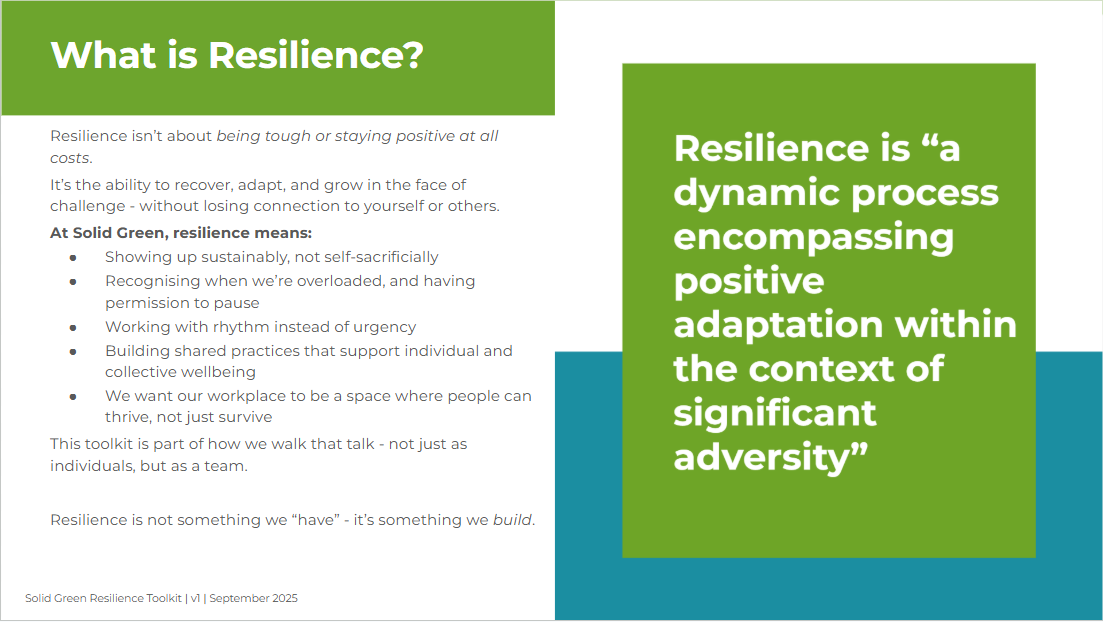
The word “resilience” often gets tossed around in the workplace as a synonym for coping, bouncing back, or pushing through. But for us, resilience is not about enduring at all costs – it’s about adapting intelligently, sustaining impact, and staying well over time.
This shift in perspective has been foundational to the development of the Solid Green Workplace Resilience Programme. We didn’t want to bolt on a mental health workshop or a once-off training. We wanted to embed resilience into the way we think, lead, collaborate and show up for one another.
Why This Matters in Sustainability Work
Professionals working in green building and sustainability often face a unique emotional terrain:
- We are expected to be both idealistic and practical.
- We must hold long-term visions while managing today’s problems.
- We navigate global systems while working on local realities.
This duality is exhilarating, but it can also be exhausting.
That’s why our resilience training is designed specifically with our context in mind. It addresses not only mental health and personal well-being, but also workload, systems pressure, collaboration dynamics, and leadership style, because these are the real levers of sustainable performance.
Walking Our Talk
As a company known for certifications, strategies, and measurable outcomes, we knew we had to apply the same rigour to our internal development. That’s why we started by testing and prototyping the resilience programme within our own team.
- We ran assessments to understand where our people feel stretched or supported.
- We offered group check-ins and tools aligned with our broader strategy.
- We used feedback loops to adapt the process in real-time.
This wasn’t just a pilot. It was a commitment to live our values from the inside out.
What’s Next
This article is the first in a series exploring the inner architecture of our Workplace Resilience Programme – what it looks like, how it works, and what we’re learning along the way.
Because if we’re going to help clients build resilient cities, resilient precincts, and resilient strategies, we need to first understand what it means to build resilient teams.
And that starts with us.
Let’s Keep the Conversation Going
This series is written by Adrie Fourie, Head of the Sustainable Cities & Research Department at Solid Green. If you’re curious about how workplace resilience could support your team or how we’re integrating this thinking into our broader sustainability work, feel free to reach out.
Stay tuned for the next article in the series: The Anatomy of a Resilience Programme.

